
Despite sharp interest rate cuts expected in this financial year amid easy liquidity conditions, state-run banks are treading cautiously on their loan growth projections for FY26. Most large banks are projecting loan growth at 11-13 per cent, almost similar to the previous financial year.

The Income-Tax (I-T) Department has detected widespread tax evasion involving cryptocurrencies and, according to media reports, has issued emails to thousands of defaulting taxpayers seeking transaction details. Investors must understand the tax rules governing crypto assets and respond promptly to these emails.

Since Sanjay Malhotra took office as governor in December, the Reserve Bank of India (RBI) has adopted a more accommodative stance, which bodes well for banking and the economy as they navigate a growth slowdown, according to analysts.

Escalating trade tensions amid a tariff war after Donald Trump took over as President of the United States (US) could adversely impact global growth and fuel inflation, an article on the "State of the Economy" in the Reserve Bank of India (RBI) monthly bulletin said.

After effecting two back-to-back 25 basis points rate cuts, Reserve Bank Governor Sanjay Malhotra on Wednesday hinted at another reduction in key policy rate by changing the central bank's monetary stance to 'accomodative' from 'neutral', which may further lower EMIs for consumers.

The Monetary Policy Committee (MPC) may go for a hike of up to 0.25 per cent in the reverse repo rate at which the RBI absorbs excess liquidity and leave the repo rate at which it lends, to narrow the policy rate corridor, a British brokerage said on Thursday. "Growth concerns amid spread of the Omicron variant and relatively benign inflation out-turns provide the RBI with enough room to maintain its growth-supportive monetary policies," analysts at Barclays said, ahead of the resolution announcement next week. The RBI will hike the reverse repo rate by 0.20-0.25 per cent, given its liquidity management actions, it said.

The Reserve Bank of India (RBI) on Friday hiked repo rate by 50 basis points to 5.90 per cent in order to control the rising inflation, keeping in line with the aggressive policies of central banks and the volatile markets prevalent across economies. RBI Governor Shaktikanta Das announced the rate hike today. In the meeting of the Monetary Policy Committee (MPC) that started on Wednesday, five of the members of the MPC voted to hike the key lending rate, repo rate, by 50-basis points (bps).

While demand for sub Rs 50-lakh affordable housing prevails, market players cite increased land rates, escalated construction costs and low margins as key prohibiting factors.

ICICI Bank has cut its savings account deposit interest rate by 0.25 per cent, according to the lender's website. The second largest private sector bank's move comes days after larger rival HDFC Bank announced similar move amid a spate of cuts in deposit offerings following RBI's two back-to-back rate decreases.

With the RBI infusing Rs 7.5 lakh crore in liquidity -- and possibly more in the future -- the short- to medium-term corporate bond market is expected to benefit.

State Bank of India, Tech Mahindra, Larsen & Toubro, Tata Steel, Sun Pharma, Infosys, HCL Tech, Axis Bank, Tata Consultancy Services and NTPC were among the biggest laggards among Sensex shares. Nestle, Hindustan Unilever, Titan, Power Grid, UltraTech Cement and ITC were among the gainers.

State Bank of India, Adani Ports, Tata Consultancy Services, ICICI Bank, Reliance Industries and PowerGrid were also among the laggards.
Higher for longer' may be the narrative in the developed markets, but interest rates might not stay high for very long in India, with a section of the market expecting rate cuts to begin this year. The six-member Monetary Policy Committee of Reserve Bank of India (RBI) decided to keep interest rates unchanged at 6.5 per cent in the April review - after hiking the policy repo rate in six previous meetings. RBI Governor Shaktikanta Das emphasised that the pause was only for the April policy and that the central bank was ready to act if the situation demanded.

'Now we have one of the best asset qualities in the industry.'

Housing demand should improve nationwide after the Reserve Bank of India (RBI) cut the repo rate by a larger-than-expected 50 basis points (bps) on Friday, said real estate industry executives. The rate cut comes after housing sales in top Indian cities in the first quarter of 2025 dipped 28 per cent due to skyrocketing residential property prices and geopolitical headwinds, according to Anarock.

Hero MotoCorp on Tuesday posted 24 per cent increase in consolidated profit after tax at Rs 1,169 crore for the fourth quarter ended March 31, 2025 riding on higher margins backed by better product mix, parts revenue and cost effectiveness. The company had reported a consolidated profit after tax (PAT) of Rs 943 crore in January-March FY24.

Fada estimates that global supply chain headwinds like scarce availability of rare earth elements for electric vehicle components and geopolitical tensions may affect urban consumer sentiment in June as well.

With retail inflation surprising on the upside, the six-member monetary policy committee (MPC) of the Reserve Bank of India (RBI) is expected to increase the repo rate by 35-50 basis points (bps) in the review scheduled for September 28-30. According to economists, the central bank will continue to focus on bringing inflation down even though economic growth has remained sluggish. Data released by the government on Monday showed that the consumer price index (CPI)-based inflation increased by 7 per cent year-on-year (YoY) in August, thus, staying above the upper tolerance limit of the central bank for all the eight months of 2022.

The interest rate on these schemes have remained unchanged for over a year now.

'The RBI's MPC will maintain the current policy rates (6.50%) at the policy meeting, given ongoing inflationary pressures.'

'Although we are facing constraints related to lending and resource mobilisation, the government is aware of these.'
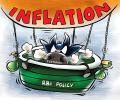
Retail inflation slipped to seven-month low of 3.61 per cent in February mainly due to easing prices of vegetables, eggs, and other protein-rich items, creating space for the RBI to go for another cut in interest rate next month.

'The central bank has highlighted that the slowdown in growth has been limited to a few sectors and overall growth is expected to pick up in the second half of the year.'
The RBI is likely to reduce the key interest rate by 25 basis points this week after keeping it on hold for two years, complementing the Union Budget initiatives to push consumption-led demand, though the sliding rupee continues to be a concern. As the retail inflation has remained within the Reserve Bank's comfort zone (less than 6 per cent) for most of the year, the central bank can take rate action to boost growth hit by sluggish consumption, opined experts.

The Reserve Bank of India (RBI) on Friday cut the repo rate by 25 basis points to 6.25 percent, marking the first reduction in five years. The central bank also projected GDP growth for fiscal year 2026 at 6.7 percent and inflation to come down to 4.2 percent in FY26 from 4.8 percent in FY25. The RBI said the global economic backdrop remains challenging but the Indian economy continues to remain strong and resilient.

A day after his appointment as the 26th governor of the Reserve Bank of India (RBI), outgoing Revenue Secretary Sanjay Malhotra on Tuesday said one must understand the economic landscape and do what was best for the economy. "Let me first go, join, understand the turf ... Here it is a different role," Malhotra said, speaking to reporters in front of North Block.

Ask rediffGURU and PF expert Milind Vadjikar your insurance, stocks, mutual fund and personal finance-related questions.

Amid liquidity tightness in the banking system, certificate of deposit (CD) rates topped 8 per cent for some smaller banks, with rates remaining on the higher side for derivatives loss-hit IndusInd Bank. On Thursday, CSB Bank raised Rs 100 crore via one-year CDs at 8.5 per cent, while Utkarsh Small Finance Bank issued three-month CDs at 8.05 per cent to raise Rs 50 crore.

'Choose an FD tenure that provides a balance between returns and the horizon for which you can invest.'

After raising interest rate by a cumulative 250 basis points in 11 months, the Reserve Bank of India (RBI) on Thursday unexpectedly kept benchmark rate unchanged as global banking woes added uncertainty to the economic outlook. Five out of six members of MPC voted to remain focused on the withdrawal of accommodation to ensure inflation aligns with target while focusing on growth, RBI Governor Shaktikanta Das said on Thursday. The Monetary Policy Committee of the central bank decided to take a pause after a rate hike seen in previous six consecutive policies.

S&P Global Ratings on Tuesday cut India's GDP growth projections to 6.5 per cent for the next fiscal as it expects that economies in the APAC region will feel the strain of rising US tariffs and pushback on globalisation. In its Economic Outlook for Asia-Pacific (APAC), S&P said despite these external strains, it expects domestic demand momentum to remain solid in most emerging-market economies.

Despite gross domestic product (GDP) growth being lower-than-expected for the July-September quarter, the six-member Monetary Policy Committee (MPC) may not cut the policy repo rate in the review meeting scheduled for next week due to high inflation in October, according to experts. "Consumer Price Index (CPI) inflation breaching the upper limit of the RBI's tolerance band in October (6.2 per cent year-on-year) is not a favourable backdrop for the MPC to commence the easing cycle, even as the growth outcome disappointed the MPC's expectations," said Shreya Sodhani, regional economist at Barclays, who expects the policy repo rate to be kept unchanged in the December meeting.

Jio Finance, a wholly owned subsidiary of Jio Financial Services, is likely to delay its maiden bond issue of Rs 3,000 crore, originally scheduled for this month. The decision comes amid expectations of softening yields in April because the Reserve Bank of India's (RBI's) monetary policy committee (MPC) is widely expected to cut the policy repo rate by another 25 basis points, sources said.

One should avoid keeping excessive funds in one's savings account.

The Reserve Bank is unlikely to cut the benchmark interest rate in its forthcoming bi-monthly monetary policy review later in the week as retail inflation is still a cause of concern, and there is a possibility of the Middle East crisis deteriorating further, impacting crude oil and commodity prices, say experts.

Union Finance Minister Nirmala Sitharaman's call for making lending rates affordable may not resonate anytime soon as banks still struggle with margin compression, and await clues from the Reserve Bank of India (RBI) on liquidity and rate action. Hinting that any lending rate cut was some time away, State Bank of India (SBI) managing director Vinay M Tonse said there was still some aggression in the market regarding deposit pricing.

Net profit of 19 listed banks is likely to decline by 4 per cent year-on-year (Y-o-Y) for the quarter ended March (Q4FY25) mainly due to pressure on net interest margins (NIM) as a result of rate cut by the Reserve Bank of India (RBI), according to analysts' estimates. Additionally, loan growth is expected to further slowdown amid low demand in certain secured products, stress in the unsecured segment, and a high cost to deposit (CD) ratio across the system.
RBI cuts GDP growth projection to 6.6 per cent for current financial year, from earlier forecast of 7.2 per cent.

Review your family emergency fund and replenish it if needed. Revisit financial goals to see if there is any change in timeline or the corpus required.

Retail inflation dipped marginally to a nearly six-year low of 3.34 per cent in March due to a decline in prices of vegetables and protein-rich items. The Consumer Price Index (CPI) based inflation was 3.61 per cent in February and 4.85 per cent in March last year.
